


Imagine telling an AI:
“Find three suitable hotels for my business trip next month, compare their prices and locations, check whether they have meeting rooms, and prepare the best options for me.”
A normal AI chatbot might give you suggestions and wait for another prompt.
An agentic AI system can potentially take the goal much further. It may break the request into smaller tasks, search available information, compare results, use connected tools, check whether its work meets your requirements, and decide what to do next.
That difference is what makes agentic AI important.
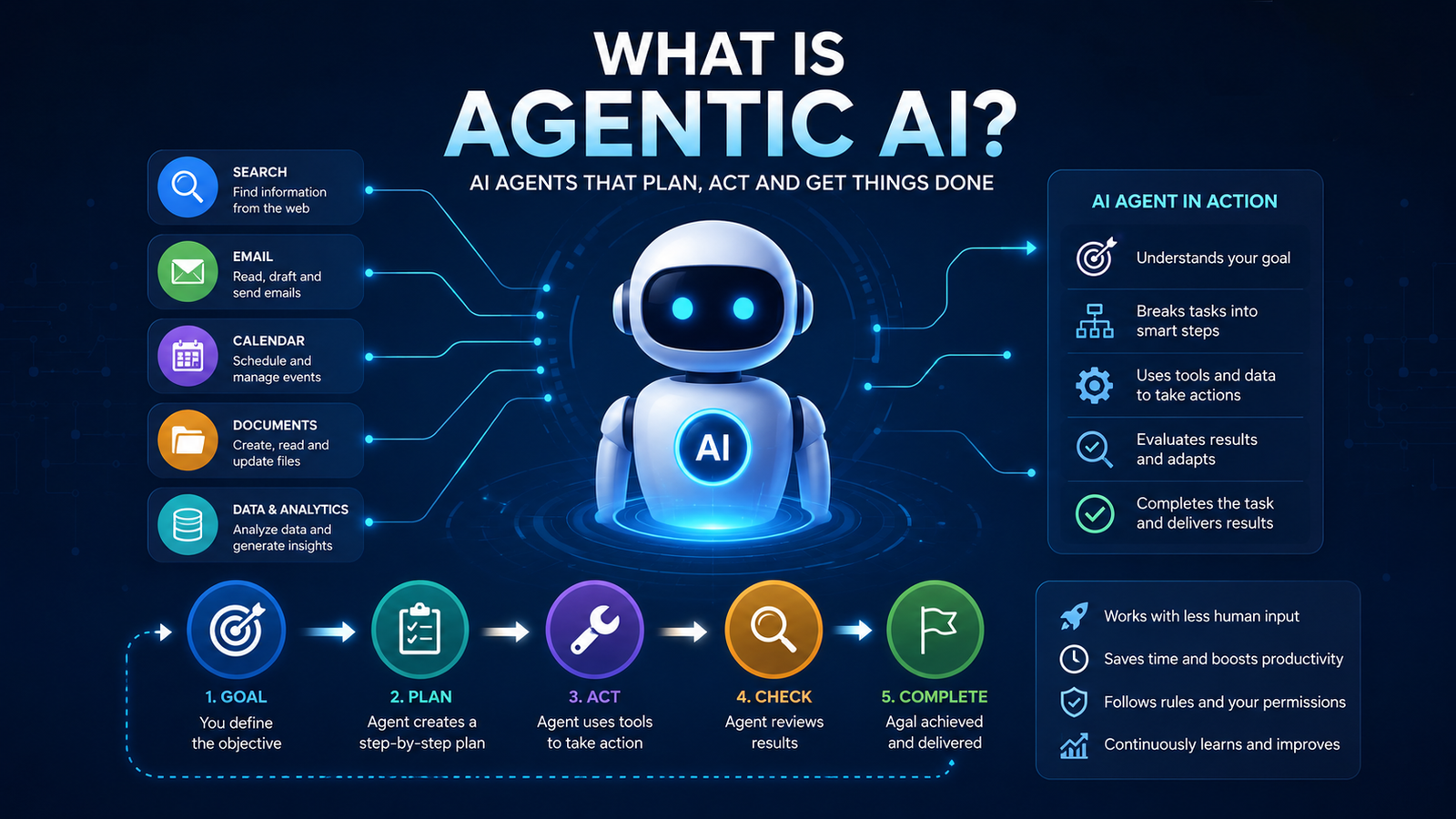
Agentic AI refers to AI systems designed to pursue goals, make decisions, use tools, and complete multiple steps with a degree of autonomy instead of requiring a human instruction for every individual action.
The human still defines the goal and should control important boundaries. But within those boundaries, an AI agent can decide how to move from the starting point toward the desired result.
This is a significant shift from AI that simply answers questions to AI that can take actions.
A Simple Way to Understand Agentic AI
Think about the difference between giving someone instructions and giving them responsibility for an outcome.
With a basic assistant, you might say:
“Open the spreadsheet.”
Then:
“Find customers who have not paid.”
Then:
“Create a list of overdue accounts.”
Then:
“Write reminder emails.”
Then:
“Send the drafts to me for approval.”
You are controlling every step.
With an AI agent, the instruction could be closer to:
“Review overdue customer accounts and prepare payment reminders for anything more than 30 days late.”
The agent then needs to determine what actions are necessary.
It may:
- Access the customer database.
- Find unpaid invoices.
- Calculate how overdue each invoice is.
- Filter invoices older than 30 days.
- Retrieve customer information.
- Draft suitable reminder messages.
- Flag unusual cases.
- Present the results for human approval.
The important feature is not simply that AI is involved.
The important feature is goal-directed autonomy.
Agentic AI vs Generative AI
Agentic AI and generative AI are closely connected, but they are not the same thing.
Generative AI is mainly designed to create or transform content. It can generate text, code, images, summaries, audio, and other outputs.
Agentic AI focuses more on achieving an objective through actions and decisions.
| Generative AI | Agentic AI |
|---|---|
| Responds mainly to prompts | Works toward a defined goal |
| Commonly produces content | Can perform sequences of actions |
| Usually waits for the next instruction | Can decide what step should come next |
| May answer from available context | May gather additional information using tools |
| Often handles one interaction at a time | Can manage multi-step workflows |
| Output may be the final result | Output may trigger another action |
The two technologies can also work together.
An AI agent may use a large language model to understand instructions, generate text, reason about possible actions, or interpret information. It may then use software tools to actually perform parts of the task.
If you want more background on the business side of this transition, TechyTune has previously explored how AI is transforming everyday business operations.
What Makes an AI System an “Agent”?
Calling every AI-powered feature an agent can make the term confusing.
A useful way to think about a genuine AI agent is to look for several capabilities working together.
It Has a Goal
An agent needs something to accomplish.
The goal might be simple:
“Schedule a suitable meeting.”
Or much broader:
“Reduce unresolved customer-support requests.”
The agent uses this objective to judge which actions are useful.
It Can Observe Its Environment
An agent needs information before it can act intelligently.
Depending on the system, it might receive information from:
- A user
- A database
- A website
- An API
- A CRM
- A document
- A calendar
- An email account
- A software application
- Sensors or connected devices
This information gives the agent its current view of the situation.
It Can Decide What to Do
Instead of following one fixed sequence every time, an agent may choose the next step based on what it discovers.
Suppose an agent is checking an order.
If the order has shipped, it may retrieve tracking information.
Also, If it has not shipped, it may check inventory.
If the item is unavailable, it may look for an approved replacement or escalate the case.
Different information leads to different actions.
It Can Use Tools
This is one of the biggest differences between a conversational AI and a more capable AI agent.
A language model can generate a sentence saying:
“Your meeting has been scheduled.”
But generating that sentence does not actually create a calendar event.
For that, the system needs access to a calendar tool or API.
Agents can potentially interact with external tools that allow them to search, calculate, retrieve records, update software, create files, send information, or perform other permitted actions.
It Can Evaluate Results
An agent should not blindly assume that every action succeeded.
After completing a step, it may inspect the result.
Did the search return useful information?
Did the API request succeed?
Is the selected time still available?
Does the result satisfy the user’s conditions?
If not, the agent may try another approach.
This creates a feedback loop instead of a simple one-way response.
How Does Agentic AI Work?
The exact architecture varies, but many agentic systems can be understood through a simple cycle:
Goal → Observe → Plan → Act → Check → Adjust
Let’s examine that process using a practical example.
Suppose you tell an AI travel agent:
Find a suitable hotel near my conference venue for three nights. Keep the total cost under my budget and prioritize properties with breakfast and free cancellation.
Step 1: Understand the Goal
The agent first identifies the important constraints.
In this example:
- Location near the conference
- Three-night stay
- Maximum budget
- Breakfast preferred
- Free cancellation preferred
A poorly designed system may treat the request as a general hotel search.
A better agent recognizes that these conditions determine whether a result is actually useful.
Step 2: Create a Plan
The system may decide that it needs to:
- Identify the conference location.
- Search available hotels.
- Check prices for the correct dates.
- Measure or estimate distance.
- Check cancellation terms.
- Check breakfast availability.
- Remove unsuitable results.
- Rank the remaining choices.
The user did not have to manually request each action.
Step 3: Use the Necessary Tools
The agent could call a hotel search service, mapping service, calculator, browser, or other connected system.
This is where agentic AI moves beyond text generation.
The AI is using software capabilities to obtain information or complete actions.
Step 4: Examine the Results
Suppose the first hotel is cheap but 15 kilometres away.
The second is nearby but exceeds the budget.
The third fits the budget, includes breakfast, and offers free cancellation.
The agent evaluates these results against the original goal instead of simply returning everything it found.
Step 5: Adjust the Plan
What if no hotel satisfies every requirement?
An agent might modify its strategy.
For example, it could widen the search radius while keeping the budget unchanged.
Alternatively, it could identify the closest matches and explain which requirement each option fails to meet.
This ability to change course is an important part of agentic behaviour.
Step 6: Request Human Approval When Necessary
Autonomy does not mean an agent should have unlimited authority.
Finding hotels is one thing.
Spending money is another.
A well-designed system might research and recommend independently but require the user to approve the final booking.
That distinction becomes increasingly important as agents gain access to more powerful tools.
The Agentic AI Loop
A simple agent loop looks like this:
Human gives goal
↓
Agent understands task
↓
Agent plans next action
↓
Agent uses a tool
↓
Agent observes the result
↓
Agent asks: “Is the goal complete?”
↓
No → choose another action
Yes → return result or request approval
The loop may happen several times during a single task.
That is why interacting with an agent can feel different from chatting with a traditional AI assistant.
You are not necessarily directing every move. You are defining the destination.
Where Does Memory Fit Into AI Agents?
Memory can make agents significantly more useful, although not every agent has long-term memory.
There are different forms of useful context.
Short-Term Context
The agent remembers information needed during the current task.
For example, while planning a trip, it may keep track of:
- Dates
- Budget
- Destination
- Preferred location
- Options already rejected
Without this context, it could repeatedly make the same mistakes.
Long-Term Preferences
Some systems may be designed to retain permitted preferences across tasks.
For example, a travel assistant might know that a user normally prefers morning flights.
This can reduce repeated instructions, but persistent memory also creates important privacy and control questions.
Users should know what information is being stored and be able to manage it appropriately.
Task History
An agent can also benefit from knowing what actions it has already attempted.
If one approach failed, the system should not keep repeating it indefinitely.
Task history allows it to adjust its strategy.
AI Agents vs Traditional Automation
Businesses have automated work for decades, so why is agentic AI different?
Traditional automation normally depends heavily on predefined rules.
For example:
If invoice is 30 days overdue → send reminder template A.
This works extremely well when the process is predictable.
An AI agent can potentially deal with less structured situations.
It might examine the invoice, customer history, previous communication, account status, and company policy before deciding what action is appropriate.
| Traditional Automation | AI Agent |
| Follows predefined rules | Can choose among possible actions |
| Best for predictable processes | Better suited to some variable workflows |
| Exceptions often require humans | May handle certain exceptions itself |
| Logic is explicitly programmed | Some decisions can be model-driven |
| Same input usually follows the same path | Path can change based on context |
| Limited interpretation of unstructured data | Can work with natural language and documents |
This does not mean AI agents should replace traditional automation.
In fact, predictable workflows often should remain predictable.
If a simple rule can safely solve a problem, adding an autonomous agent may introduce unnecessary cost and complexity.
The strongest systems may combine both approaches.
Single-Agent and Multi-Agent Systems
Not every agentic system uses one AI agent.
Single-Agent Systems
One agent manages the overall task and uses several tools.
For example, a research agent might search sources, read documents, compare information, and produce a report.
This approach is relatively straightforward.
Multi-Agent Systems
A more complex system can assign different roles to multiple agents.
Imagine preparing a market analysis.
One agent could collect information.
Another could analyse competitors.
A third could examine financial data.
A fourth could review the final report for inconsistencies.
The agents may exchange information before producing the final result.
Multi-agent designs can be useful for complicated workflows, but adding more agents does not automatically make a system better. More components can also mean more cost, latency, coordination problems, and opportunities for errors.
Where Agentic AI Can Be Useful
Agentic AI becomes especially interesting when a task requires several connected actions rather than one answer.
Customer Support
An AI agent could do more than answer a customer’s question.
With suitable permissions, it might:
- Identify the customer
- Retrieve the order
- Check shipping status
- Review company policy
- Determine available options
- Update a support ticket
- Escalate unusual cases
The value comes from connecting understanding with action.
Software Development
Coding agents can potentially inspect a codebase, identify relevant files, write code, run tests, examine errors, modify the code, and test again.
That iterative process is much closer to completing a task than simply generating a code snippet.
Research
A research agent may turn a broad question into smaller questions, gather information from multiple sources, compare evidence, identify missing information, and prepare a structured result.
Human verification remains important, particularly when factual accuracy matters.
IT Operations
Agents may help examine system alerts, collect logs, identify possible causes, run approved diagnostic actions, and escalate serious incidents.
High-risk changes should still have strong permission controls.
Sales and Business Operations
An agent could potentially review incoming leads, gather account information, update CRM records, prepare personalized outreach, or identify follow-up tasks.
This connects naturally with the wider use of AI in everyday business operations.
Personal Productivity
AI agents may also assist individuals with tasks involving calendars, documents, email, research, reminders, travel planning, and other digital workflows.
The important question is always what access the agent has and what actions it is allowed to perform.
Why Agentic AI Is Getting So Much Attention
Generative AI proved that machines could interact with people through surprisingly natural language.
Agentic AI asks the next question:
What happens when the AI can do something with that understanding?
A chatbot that explains how to perform a task can save time.
An agent that safely completes parts of that task can potentially save much more.
That could change the role of AI inside software.
Instead of opening an application, navigating several menus, entering information, copying data between systems, and checking the result manually, a user may increasingly describe the outcome they want.
The software then handles more of the process.
However, greater autonomy also creates greater responsibility.
The Biggest Limitation: Agents Can Still Be Wrong
An AI agent may appear confident while misunderstanding a request or relying on incorrect information.
Large language models can produce inaccurate information, sometimes called hallucinations.
TechyTune recently discussed the risks of publishing unchecked AI-generated material in its guide to AI slop and low-quality AI content. The same underlying accuracy problem becomes even more important when an AI system can take actions.
A wrong paragraph is inconvenient.
A wrong action can have consequences.
Imagine an agent:
- Sending an email to the wrong person
- Changing the wrong record
- Purchasing the wrong product
- Deleting an important file
- Misinterpreting company policy
- Acting on outdated information
For this reason, capable agents need more than intelligence. They need boundaries.
Human-in-the-Loop Still Matters
“Works without constant human input” should not be interpreted as “humans are no longer needed.”
A better model is human-on-the-loop or human-in-the-loop, depending on the risk.
An agent may work independently on low-risk steps while requesting approval before important actions.
For example:
Low risk: Search available flights.
Moderate risk: Prepare a shortlist.
Higher risk: Book a non-refundable ticket.
The first two actions may be suitable for greater autonomy.
The final action may require explicit approval.
The amount of human oversight should increase with the potential consequences of an error.
What Can Go Wrong With Agentic AI?
The ability to act introduces risks that ordinary chat interfaces do not face to the same degree.
Incorrect Decisions
An agent may misunderstand instructions or make a poor judgment.
Excessive Permissions
An agent with access to email, files, financial systems, customer data, and administrative controls could cause significant damage if something goes wrong.
Agents should receive only the permissions necessary for their task.
Bad or Malicious Instructions
Agents that interact with websites, documents, emails, or other external content may encounter instructions that should not be trusted.
Systems need safeguards to distinguish the user’s actual goal from untrusted content encountered during a task.
Privacy Problems
Agents may process sensitive information while moving between different applications and services.
Organizations need clear rules about what data agents can access, retain, and share.
Cascading Errors
A single incorrect assumption can affect several later steps.
An agent might make decision A, use it to perform action B, and then base decisions C and D on the incorrect result.
Monitoring and checkpoints help reduce this risk.
Unclear Accountability
If an autonomous system makes a costly mistake, organizations still need to know who is responsible for its deployment, permissions, supervision, and outcomes.
“AI did it” is not an accountability system.
When Should You Use an AI Agent?
Agentic AI is most useful when a task involves:
- Multiple connected steps
- Information gathering
- Decisions based on changing conditions
- Several software tools
- Repeated but not completely predictable work
- A clear goal that can be evaluated
It may be unnecessary when a simple rule, script, search, calculator, or traditional automation can solve the problem reliably.
A useful question is:
Does the task actually require judgment and adaptation, or are we adding AI because it sounds more advanced?
The simplest reliable solution is often the better solution.
How Businesses Should Approach AI Agents
Organizations considering agentic AI should start with the workflow rather than the technology.
First identify a real problem.
Then define exactly what the agent should accomplish, what information it needs, what systems it can access, and which actions require human approval.
Start with limited permissions.
Test common cases as well as unusual ones.
Keep logs of important actions.
Measure whether the system actually saves time or improves outcomes.
And make sure there is a clear way for a human to intervene.
Companies exploring broader AI infrastructure should also consider issues such as model selection, data security, cost, scalability, and monitoring. TechyTune’s guide to implementing generative AI development services covers several of these underlying considerations.
Will AI Agents Replace Apps?
Probably not in the simple sense of apps disappearing.
A more realistic possibility is that agents become another way of interacting with software.
Today, users often need to understand how an application is organized.
They need to know which menu to open, what button to click, which filters to select, and what information to enter.
An agent can potentially translate a goal expressed in natural language into those software actions.
Instead of learning every interface, a user may increasingly say:
“Compare my schedule with Sarah’s and find three possible meeting times next week.”
The agent handles the software interactions behind the request.
Apps and APIs still exist underneath. The interaction layer changes.
Is Agentic AI Fully Autonomous?
Usually, autonomy exists on a spectrum.
An AI system could have very limited authority and ask for confirmation frequently.
Another could independently complete many low-risk tasks.
A specialized industrial agent might operate continuously within strict rules.
Therefore, describing something as “agentic” does not tell you exactly how independent it is.
When evaluating an AI agent, ask:
What can it see?
What can it decide?
Also, What can it change?
What requires approval?
What happens when it is uncertain?
Those questions tell you more than the label.
The Future of Agentic AI Is About Delegation, Not Just Conversation
The first wave of widely used generative AI made natural-language interaction with machines much easier.
Agentic AI pushes the idea further.
Instead of asking AI only to tell us how to do something, we can increasingly delegate parts of the work itself.
That does not mean giving AI unlimited freedom.
The useful model is controlled delegation.
Humans define goals, permissions, rules, and important checkpoints. The agent handles appropriate steps inside those boundaries and returns to the human when judgment or authorization is required.
This could gradually change our relationship with software.
The question may shift from:
“Which buttons do I need to click?”
to:
“What outcome do I want?”
Final Thoughts
Agentic AI is an approach to artificial intelligence in which AI systems can pursue goals through a sequence of decisions and actions without needing a human to manually direct every step.
An effective AI agent can understand a goal, gather information, create a plan, use tools, observe results, adjust its approach, and determine whether more work is required.
That makes agentic AI potentially more powerful than a chatbot that simply responds to prompts.
It also makes safety, permissions, monitoring, accuracy, and human oversight more important.
The future of AI is therefore unlikely to be defined only by models that can generate better answers.
A much bigger change may come from systems that can turn those answers into carefully controlled actions.
And that is the key idea behind agentic AI: not AI operating without humans, but AI capable of doing more of the work between a human’s goal and the final result.

Comments are closed.