


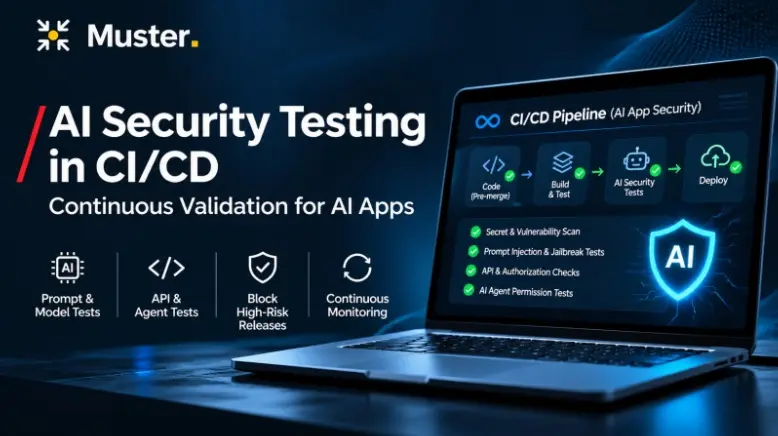
AI applications are evolving rapidly, and development teams are integrating large language models (LLMs), AI agents, retrieval-augmented generation (RAG), and third-party AI APIs into modern software. While these technologies introduce new capabilities, they also create security risks that traditional application security testing may not fully address.
A single insecure prompt-handling mechanism, exposed API key, excessive agent permission, or vulnerable integration can expose sensitive information or allow attackers to manipulate an AI-powered application.
Traditional security testing often happens late in the development lifecycle. However, identifying AI security weaknesses only before production or after deployment can increase remediation costs and introduce unnecessary release delays.
AI security testing in CI/CD helps development and security teams continuously validate AI applications throughout the software delivery lifecycle. By integrating automated security checks, AI-specific test cases, API assessments, and targeted penetration testing into development pipelines, organisations can identify vulnerabilities earlier and make more informed release decisions.
This guide explains how to implement continuous AI security testing, what to test at each CI/CD stage, and how AI penetration testing can strengthen application security.
1. Why AI Security Belongs in CI/CD
Continuous Integration and Continuous Delivery (CI/CD) pipelines help development teams automate code integration, testing, building, and deployment. Security testing should be part of this process rather than a separate activity performed only before launch.
AI applications introduce additional attack surfaces that require specialised validation.
For example, an AI-powered customer support application might connect an LLM to customer databases, internal documents, external APIs, and automated business workflows. A vulnerability in one integration could allow unauthorised access to sensitive information.
Traditional security checks may identify coding errors or vulnerable dependencies, but they might not detect prompt injection, insecure AI tool usage, or unintended model behaviour.
Integrating AI security testing into CI/CD helps organisations:
- Identify AI-specific vulnerabilities earlier in development.
- Detect exposed API keys and sensitive configuration data.
- Test prompt injection and jailbreak resistance.
- Validate authentication and authorisation across AI APIs.
- Identify insecure agent permissions and tool integrations.
- Evaluate changes in model behaviour after updates.
- Reduce the risk of deploying vulnerable AI applications.
The objective is not to make every pipeline run a complete penetration test. Instead, organisations should implement security checks appropriate to each development stage and perform deeper assessments when necessary.
2. Pre-Merge Checks for AI Application Security
Pre-merge checks are the first opportunity to identify security issues before code changes enter the main development branch.
Whenever developers submit a pull request, automated security checks can analyse the proposed changes and identify potential vulnerabilities.
For AI applications, these checks should cover traditional application security as well as AI-specific risks.
Recommended pre-merge security checks
Secret Detection
Scan code changes for exposed API keys, model provider credentials, database passwords, access tokens, and other sensitive configuration values.
Static Application Security Testing (SAST)
Analyse source code to identify insecure coding patterns, unsafe input handling, weak authentication mechanisms, and other potential vulnerabilities.
Software Composition Analysis (SCA)
Identify vulnerable open-source libraries, outdated dependencies, and insecure packages used by AI applications.
AI Configuration Validation
Review model configurations, system prompts, tool permissions, and environment variables for potentially unsafe settings.
Infrastructure-as-Code Security
Check cloud configurations, containers, deployment manifests, and infrastructure definitions for misconfigurations that could expose AI services.
Pre-merge checks should provide developers with actionable findings, including the affected file, vulnerability category, severity, and remediation guidance.
This approach helps prevent known security issues from progressing into later development stages.
3. Build and Deployment Testing
After code changes pass pre-merge checks, the CI/CD pipeline moves into the build and deployment stages.
At this point, security testing should validate the complete application environment rather than examining source code alone.
AI applications frequently depend on multiple components, including:
- Frontend applications and backend services.
- LLM APIs and model endpoints.
- Vector databases and RAG pipelines.
- Authentication and identity providers.
- External APIs and third-party integrations.
- AI agents and connected tools.
- Cloud infrastructure and container environments.
A secure codebase does not automatically guarantee a secure deployment.
For example, an application may use secure authentication logic but expose an internal AI endpoint through an incorrectly configured cloud service.
Build-stage security validation
Development teams should consider implementing:
- Container image vulnerability scanning.
- Dependency and package validation.
- API configuration checks.
- Cloud security configuration reviews.
- Access control validation.
- Network exposure assessments.
- Sensitive information detection.
Deployment-stage security validation
After deploying an application into a staging environment, teams can run dynamic security tests against the actual application.
These tests can examine authentication, authorisation, API security, input validation, session management, and exposed endpoints.
For AI applications, deployment testing should also include model interaction, prompt handling, retrieval access controls, and connected tool behaviour.
4. Prompt and Model Security Tests
AI applications introduce security challenges that traditional application testing cannot completely address.
Prompt injection, jailbreak attempts, sensitive information disclosure, and unsafe model responses can create security and privacy risks.
These risks should be evaluated whenever developers modify prompts, update models, change retrieval configurations, or introduce new AI capabilities.
Prompt injection testing
Prompt injection occurs when malicious instructions influence an AI system to ignore its intended instructions or perform unintended actions.
For example, an attacker might submit a crafted prompt designed to make a customer support chatbot reveal information from internal knowledge sources.
Security testing should evaluate whether the application:
- Separates trusted instructions from untrusted user input.
- Handles malicious instructions safely.
- Prevents unauthorised disclosure of internal information.
- Restricts access to sensitive context.
- Maintains security controls when processing external content.
Jailbreak testing
Jailbreak testing evaluates whether users can bypass an AI application’s intended restrictions through specially crafted prompts or interaction patterns.
Teams should test different attack variations rather than relying on a single predefined prompt.
Sensitive information exposure
AI applications may process personal information, confidential business documents, internal system instructions, or proprietary data.
Testing should evaluate whether the model exposes information that the requesting user is not authorised to access.
Model behaviour regression testing
Model updates, prompt modifications, and configuration changes can affect application security.
Teams should maintain a collection of security test cases and rerun them after relevant changes to identify regressions.
Importantly, model security tests should evaluate application-level controls rather than assuming that model guardrails alone provide sufficient protection.
5. API and AI Agent Security Testing
Modern AI applications often rely on APIs and autonomous agents to perform tasks beyond generating text.
An AI agent might retrieve customer information, update records, execute workflows, access internal documents, or interact with external services.
These capabilities increase the importance of API security and permission management.
API security testing
AI-related APIs should be tested for:
- Broken authentication.
- Broken object-level authorisation.
- Broken function-level authorisation.
- Excessive data exposure.
- Rate-limiting weaknesses.
- Insecure input validation.
- Improper error handling.
- Sensitive information leakage.
For example, a chatbot API might accept a customer ID from a request without verifying whether the authenticated user is authorised to access that customer’s records.
AI agent security testing
AI agents introduce additional risks because they can interact with tools and execute actions based on model-generated decisions.
Security teams should evaluate:
Excessive Agency: Can an AI agent perform actions beyond its intended responsibilities?
Insecure Tool Usage: Can malicious input manipulate the agent into using connected tools in unintended ways?
Permission Misconfiguration: Does the agent have access to sensitive systems or resources it does not need?
Unauthorised Actions: Can users trigger administrative or financial operations without proper authorisation?
Indirect Prompt Injection: Can malicious instructions hidden in retrieved documents or external content influence agent behaviour?
Each agent action should be validated against server-side authorisation policies. Critical operations should also use appropriate approval mechanisms.
6. Blocking High-Risk AI Releases
Continuous security testing becomes more effective when teams establish clear release policies.
Not every security finding should automatically block deployment. However, vulnerabilities that create significant security exposure should trigger additional review or prevent a release.
A risk-based release strategy helps balance development speed with application security.
Example AI security release policy
| Security Finding | Recommended Action |
| Critical authentication bypass | Block release |
| Unauthorised access to sensitive data | Block release |
| Exposed production API credentials | Block release and rotate credentials |
| Critical vulnerable dependency | Block or require security approval |
| Prompt injection with sensitive data exposure | Require remediation before release |
| Excessive AI agent permissions | Require remediation or approved exception |
| Low-risk informational finding | Track and review |
Organisations should define severity thresholds based on exploitability, business impact, affected assets, and exposure.
Risk-based pipeline decisions
A practical CI/CD security policy can include three outcomes:
- Pass: No release-blocking vulnerabilities are detected.
- Review: Findings require security team evaluation or an approved exception.
- Fail: Critical security issues prevent deployment.
Security exceptions should be documented with an owner, business justification, compensating controls, and an expiry or review date.
This makes security decisions transparent and reduces the risk of repeatedly accepting unresolved vulnerabilities.
7. Security Evidence and Reporting
Continuous AI security testing should produce useful evidence, not just pass-or-fail pipeline results.
Development teams need clear visibility into what was tested, which vulnerabilities were discovered, and whether previously identified issues have been resolved.
A useful AI security report should include:
- Application and environment details.
- Build or deployment version.
- Model and configuration versions.
- Security tests executed.
- Vulnerabilities identified.
- Severity and risk classification.
- Affected endpoints or components.
- Reproduction steps where appropriate.
- Remediation recommendations.
- Retest and validation results.
Why evidence matters
Security evidence helps organisations understand whether security controls are working as expected.
It also supports internal security reviews, compliance activities, vulnerability management, and communication between developers and security teams.
For example, if a new model integration introduces an unauthorised data access issue, the security report should identify the affected integration, explain the potential impact, and document the remediation and retesting process.
Reports should avoid storing actual secrets, sensitive customer information, or confidential prompt contents unnecessarily.
8. Continuous Monitoring After Deployment
AI security testing should not stop when an application reaches production.
AI systems can change over time because of model updates, new integrations, modified prompts, evolving user behaviour, and changes in external dependencies.
An application that passed security testing during deployment may become vulnerable after a configuration change or new feature release.
Continuous monitoring helps teams identify unexpected behaviour and emerging security risks.
Key areas to monitor
API Activity: Monitor unusual request patterns, authentication failures, and unexpected access attempts.
AI Usage: Identify suspicious prompt activity, unusual token consumption, and repeated attempts to bypass application restrictions.
Agent Actions: Monitor tool execution, permission usage, sensitive operations, and unexpected workflow behaviour.
Data Access: Detect unusual access to internal documents, customer records, and confidential information.
Model Changes: Track model versions, configuration changes, and updates that may affect security controls.
Dependency Updates: Monitor newly disclosed vulnerabilities in application and AI-related dependencies.
Monitoring should be supported by appropriate logging, alerting, access controls, and incident response procedures.
Security teams should also periodically repeat targeted AI security assessments and penetration testing to validate whether controls remain effective under realistic attack scenarios.
9. Implementation Roadmap for Continuous AI Security Testing
Organisations do not need to introduce every security control simultaneously. A phased approach makes implementation easier and helps development teams adopt security testing without disrupting delivery.
Phase 1: Identify AI Attack Surfaces
Start by documenting all AI-related components, including model endpoints, APIs, agents, plugins, vector databases, third-party services, and sensitive data flows.
Identify which components process confidential information or perform privileged actions.
Phase 2: Establish Pre-Merge Security Checks
Integrate secret detection, SAST, dependency scanning, and configuration validation into pull request workflows.
Establish baseline security requirements for AI-related code changes.
Phase 3: Introduce AI-Specific Security Tests
Develop test cases for prompt injection, jailbreak attempts, sensitive data exposure, insecure retrieval, and unsafe tool usage.
Run these tests whenever relevant application components or AI configurations change.
Phase 4: Validate Staging Deployments
Execute dynamic application security testing against staging environments.
Test API authentication, authorisation, model interactions, and AI agent permissions using realistic attack scenarios.
Phase 5: Establish Risk-Based Release Gates
Define which vulnerabilities require immediate remediation and which findings can proceed through security review.
Introduce documented exception processes and deployment approval requirements.
Phase 6: Enable Continuous Monitoring
Monitor production activity, model changes, API behaviour, and agent actions.
Use security findings to improve test coverage and update the CI/CD pipeline over time.
Phase 7: Conduct Regular AI Penetration Testing
Automated pipeline checks are valuable for detecting recurring and known security issues, but they cannot replace comprehensive security assessments.
Regular AI penetration testing helps identify complex vulnerabilities involving multiple components, business logic, model interactions, and chained attack scenarios.
A combination of automated security testing and expert-led assessment provides broader security coverage.
10. Frequently Asked Questions About AI Security Testing in CI/CD
What is AI security testing in CI/CD?
AI security testing in CI/CD is the process of integrating security validation into continuous integration and deployment pipelines for AI-powered applications. It includes automated checks for application vulnerabilities, prompt injection, sensitive data exposure, insecure APIs, model configurations, and AI agent permissions.
Why is continuous AI security testing important?
AI applications can introduce new vulnerabilities whenever developers modify prompts, update models, introduce integrations, or change application functionality. Continuous testing helps identify security weaknesses throughout the development lifecycle rather than relying exclusively on pre-launch assessments.
What should be tested in an AI CI/CD pipeline?
An AI CI/CD pipeline should evaluate source code, dependencies, exposed credentials, API security, authentication, authorisation, prompt injection, jailbreak resistance, sensitive information exposure, model configurations, and AI agent tool permissions.
Can traditional SAST tools detect AI vulnerabilities?
SAST tools can identify many traditional application security issues, including insecure coding patterns and certain input validation weaknesses. However, they generally cannot fully evaluate runtime AI behaviour, prompt injection, jailbreak vulnerabilities, or complex agent interactions. AI-specific security testing is also necessary.
How often should AI applications undergo security testing?
Security testing should occur throughout development. Automated checks can run during pull requests, builds, and deployments, while more comprehensive AI security assessments should be performed periodically and after significant changes to models, prompts, integrations, or application architecture.
Should AI security vulnerabilities block deployment?
Critical vulnerabilities involving authentication bypass, unauthorised data access, exposed credentials, or dangerous agent permissions should generally prevent deployment until appropriately addressed. Organisations should establish risk-based release policies based on their security requirements and business impact.
What is the difference between AI security testing and AI penetration testing?
AI security testing is a broader process that includes automated checks, configuration reviews, vulnerability scanning, and continuous validation. AI penetration testing involves a more targeted assessment in which security professionals evaluate AI applications using realistic attack scenarios to identify exploitable weaknesses and security control failures.
Can AI security testing be fully automated?
Many repetitive security checks can be automated, including dependency scanning, secret detection, API testing, and predefined prompt attack tests. However, complex attack chains, business logic weaknesses, contextual vulnerabilities, and unexpected agent behaviours often require human analysis and expert validation.
How does AI penetration testing improve CI/CD security?
AI penetration testing identifies weaknesses that automated pipeline checks may miss. Findings from penetration tests can be converted into repeatable security test cases and added to CI/CD workflows, helping teams prevent similar vulnerabilities from reappearing in future releases.
Strengthen Your AI Application Security with Muster Security
Building AI applications securely requires more than traditional vulnerability scanning. Organisations need to validate how models process instructions, how applications handle sensitive information, how APIs enforce permissions, and how AI agents interact with connected tools.
Muster Security helps organisations assess AI application security through focused security testing and penetration testing approaches.
Whether you are developing an AI-powered SaaS platform, integrating LLM APIs, deploying autonomous AI agents, or building applications with AI-generated code, identifying security weaknesses early can help reduce exposure and improve application resilience.
Explore AI Penetration Testing by Muster Security to understand how specialised assessments can help identify vulnerabilities in AI-powered applications.
You can also explore our guide to Vibe Coding Security to learn more about securing applications developed with AI coding tools.
Build, test, and deploy AI applications with security in mind. Contact Muster Security to discuss your AI application security testing requirements.

Comments are closed.