


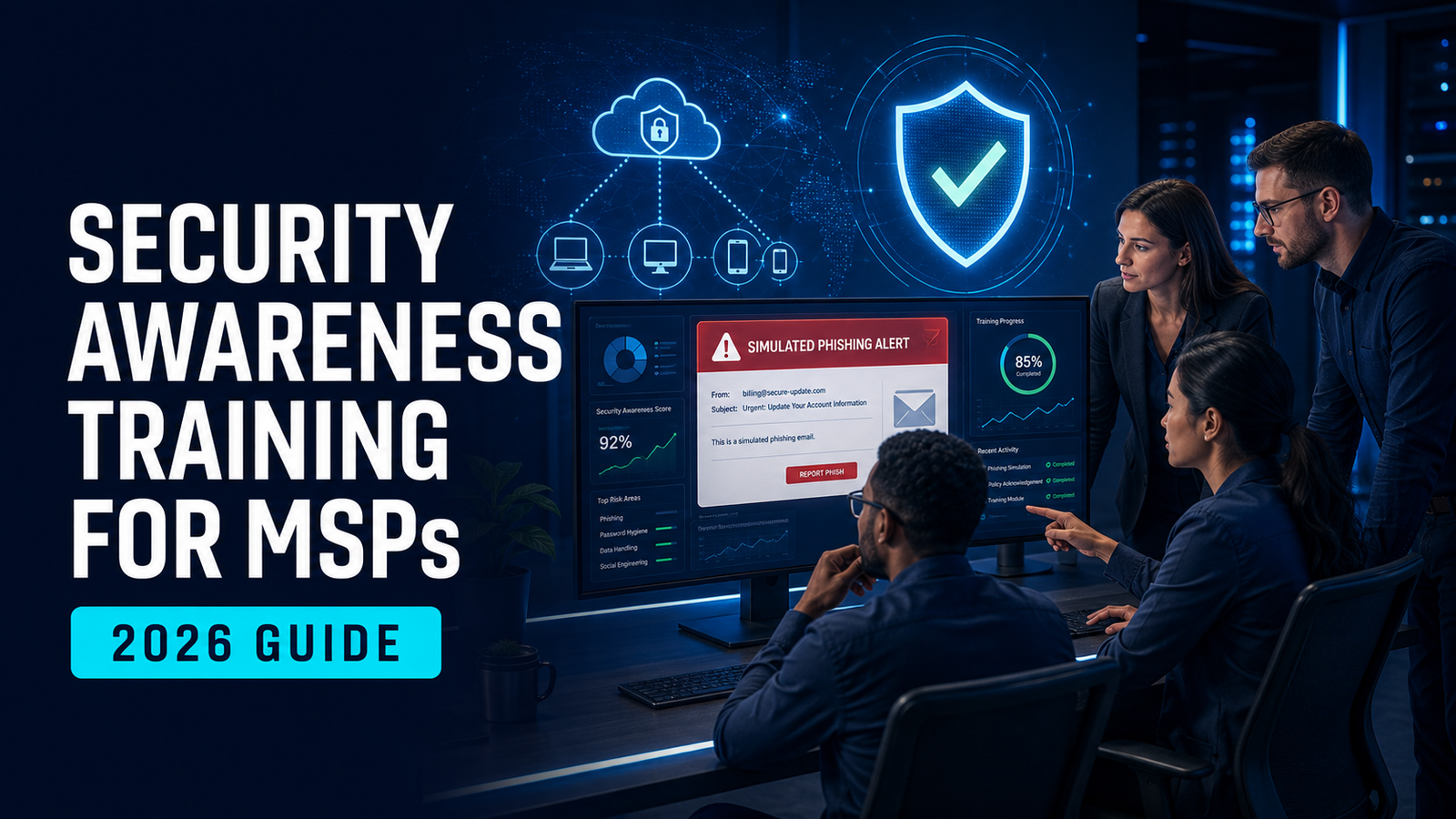
Security awareness training for managed service providers (MSPs) is a continuous, role-based program that teaches employees and client users how to prevent, recognize, and report cyber threats. In 2026, an annual video and quiz are not enough. Effective programs combine short lessons, realistic exercises, clear procedures, technical safeguards, and behavior-based measurements.
MSP technicians may hold privileged access to remote tools, cloud platforms, backups, identity systems, and several customer environments. One compromised account or rushed help-desk decision can therefore affect more than one organization.
TechyTune previously outlined how MSPs can improve cybersecurity awareness training. This guide goes further by showing how to build, operate, and measure a complete program.
Why Security Awareness Training Is Different for MSPs
An MSP must protect its own operations while supporting customers with different technologies, policies, and risk levels.
| MSP risk area | Example human error | Behavior training should reinforce |
|---|---|---|
| Privileged access | A technician approves an unexpected MFA prompt | Stop, deny, report, and verify the request |
| Service desk | An attacker persuades an agent to reset an account | Follow the identity-check process without exceptions |
| Remote management | An employee opens the wrong client tenant | Confirm the customer, device, task, and authorization |
| Finance | A fake executive requests an urgent payment | Verify through a trusted second channel |
| Customer communication | A warning is delayed or unclear | Use the agreed escalation and notification route |
Generic examples about spelling or unknown senders will not prepare an administrator for a convincing request that appears to come from a customer executive.
What an MSP Training Program Should Cover in 2026
Phishing, Business Email Compromise, and AI Impersonation
Polished writing is no longer proof that a message is genuine. The FBI warns that criminals can use AI to create convincing emails and clone voices or video. Teach people to pause when a request involves credentials, remote access, payment details, confidential data, or a process change. They should confirm it through a known number, approved ticket, or another trusted channel. A familiar voice or caller ID should not replace verification.
This matters as AI becomes part of everyday business operations and makes digital communication faster, more automated, and easier to imitate.
Identity, Passwords, and MFA
Cover password-manager use, unique credentials, unexpected sign-in alerts, session theft, MFA fatigue, and fake login pages. Privileged users should use separate administrative accounts, never share credentials, and deny MFA requests they did not initiate. Wherever supported, use phishing-resistant authentication for administrator and remote-access accounts. Training supports these controls; it does not replace them.
Service-Desk Identity Verification
Help-desk teams can reset passwords and change authentication methods, making them attractive targets. Give agents a written procedure for resets, new devices, locked accounts, and executive requests. Define acceptable evidence, callback requirements, and escalation points. Exercises should include a persuasive caller who claims an emergency and asks the agent to bypass a step.
Remote Tools and Client-Tenant Boundaries
Use scenarios involving remote monitoring tools, scripts, privileged workstations, file transfers, and customer separation. Before acting, a technician should confirm the tenant, endpoint, ticket, approval, and scope. Also cover unapproved remote tools, unusual commands, secrets in scripts, and safe handling of logs. As autonomous systems gain access to business tools, understanding how agentic AI uses permissions and performs actions becomes part of access awareness.
Data Handling, Cloud Apps, and Generative AI
Set simple rules for classifying, storing, sharing, and deleting customer data. Address cloud permissions, personal email, unauthorized SaaS, OAuth consent, and public AI services. State which AI tools are approved, what information is prohibited, whether outputs require review, and how to report exposure. TechyTune’s guide to generative AI development services and data safety explains the wider role of access control, auditing, encryption, and governance.
Fast, Blame-Free Incident Reporting
Provide one easy route for reporting a suspicious message, mistaken click, exposed credential, unusual login, or data error. Fast reporting gives the security team time to revoke sessions, isolate devices, and warn customers. Managers should reward prompt action and avoid language that encourages people to hide mistakes.
A Practical 90-Day MSP Training Plan
| Period | Main actions | Output |
|---|---|---|
| Days 1–15 | Assign an owner, review incidents, identify privileged roles, map requirements, and record a baseline | Risk-based training map |
| Days 16–30 | Create the core course, role modules, reporting instructions, and verification exercises | Curriculum and procedures |
| Days 31–60 | Train staff, run role workshops, test reporting, and brief managers | Program launch |
| Days 61–90 | Run a controlled simulation, review results, coach higher-risk groups, and brief leadership | KPI baseline and improvement plan |
NIST SP 800-50 Rev. 1 treats cybersecurity learning as a life-cycle program that supports behavior change and security culture. These 90 days begin a repeatable process rather than complete it.
Use a Cadence People Can Remember
- Security orientation before a new employee receives system access
- Five-to-ten-minute learning activities each month
- Role-based practice for technicians, finance, sales, and the service desk each quarter
- Incident-response and customer-communication exercises twice a year
- Targeted coaching after a real incident, process change, or new threat
- A full program review at least once a year
A finance user needs payment-verification practice; a technician needs privileged-access and tenant-separation scenarios.
Run Simulations Without Creating a “Gotcha” Culture
Simulations should test a defined behavior and provide immediate learning. Do not shame people or publish failure lists. Vary the format with fake support calls, QR-code lures, MFA-push attacks, file-sharing notices, and executive impersonation. The UK National Cyber Security Centre recommends layered phishing defense because training cannot stop every message. Filtering, secure authentication, limited privileges, and incident response must support it.
Measure Behavior, Not Course Completion Alone
Completion records help with governance but do not prove that people can handle a real event. Track actionable measures.
| Measure | What it reveals |
|---|---|
| Reporting rate | Whether people recognize and escalate suspicious activity |
| Median time to report | How quickly the security team receives a warning |
| Verification-process adherence | Whether help-desk and finance teams follow critical steps |
| Repeat-risk rate | Whether the same users or teams need a different intervention |
| Remediation time | Whether the MSP can contain a reported event quickly |
Do not judge the program by click rate alone. Review results by role and trend, protect employee privacy, and use findings to improve controls, procedures, and training.
Extending the Program to MSP Clients
Offer customers a shared core curriculum, then adapt scenarios to each client’s industry, tools, and approval processes. Define ownership of enrollment, simulations, reporting, evidence, and incident follow-up in the service agreement. Keep customer records separate and give leaders a concise report showing trends, unresolved risks, and recommended actions.
MSP Security Awareness Checklist for 2026
- Assign a program owner and executive sponsor.
- Map lessons to MSP roles, tools, and customer risks.
- Train staff before granting privileged access.
- Document identity checks for service-desk and payment requests.
- Provide one tested reporting channel.
- Cover AI impersonation, MFA fatigue, OAuth consent, and remote-tool abuse.
- Pair learning with MFA, least privilege, logging, and response plans.
- Review metrics quarterly and feed incident lessons back into training.
Final Takeaway
Effective security awareness training changes daily decisions. Build it around real roles, repeat learning throughout the year, and measure behavior instead of relying on certificates. Combined with strong controls and a supportive culture, it protects both the MSP and its customers.

Comments are closed.