


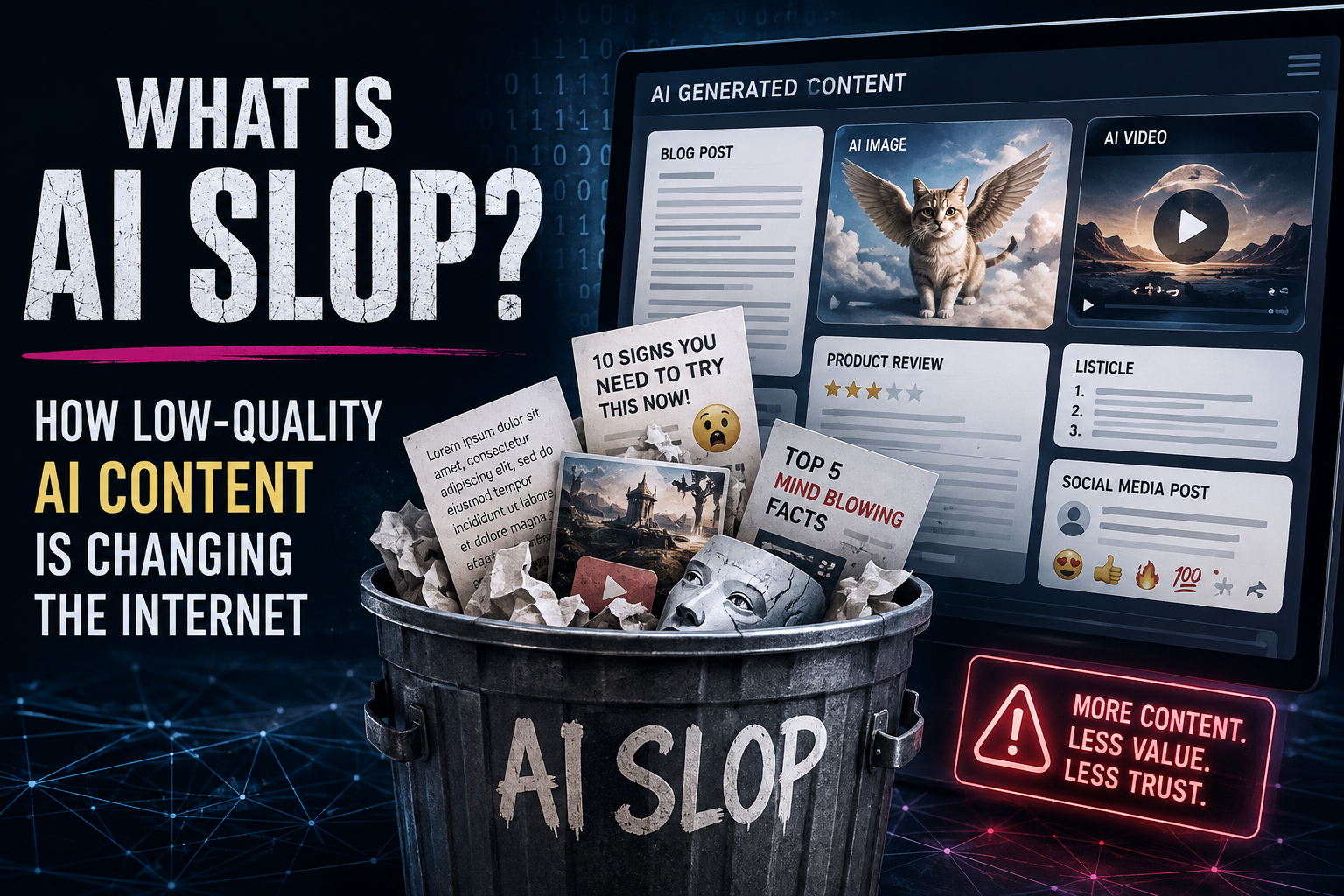
iArtificial intelligence has made creating digital content easier than ever. A person can now generate an article, image, social media post, product description, voiceover, or even a complete video within minutes.
That convenience has opened many useful possibilities. It has also created a new problem: the internet is filling with content that looks polished at first but offers very little value.
This low-effort material is increasingly called AI slop.
You may have already seen it. It could be a blog post that takes 1,500 words to explain something that could be answered in three paragraphs. Also, t might be an image showing an impossible event presented as real. It could be a social media post filled with generic advice, or a video built from artificial images, an AI voice, and a script that does not appear to have been checked by a person.
The problem is not simply that artificial intelligence was used to make the content. AI can be a valuable research, writing, coding, and productivity tool.
The real issue begins when AI makes it possible to produce content faster than people are willing to check, improve, verify, or think about it.
That difference is important.
What Is AI Slop?
AI slop is low-quality digital content created largely with generative AI and published with little human judgment, editing, fact-checking, or original input.
The term can apply to many forms of content, including:
- Articles
- Blog posts
- Social media posts
- Images
- Short-form videos
- YouTube videos
- Product reviews
- Comments
- E-books
- News summaries
- Music
- Voice recordings
- Software code
AI slop is therefore not a particular file type or technology. It describes the quality and purpose of the final output.
Imagine two people using the same AI writing tool.
The first person interviews an expert, collects original information, creates an outline, uses AI to organize some ideas, checks every claim, rewrites weak sections, and adds personal observations.
The second person enters a keyword, asks AI for a 2,000-word article, copies the result, and publishes it without checking anything.
Both used AI.
Only the second example is likely to produce what people describe as AI slop.
That distinction matters because treating all AI-assisted content as bad misses the real problem.
Why Is It Called “Slop”?
The word slop has historically been associated with something messy, undesirable, or of poor quality. Its modern internet meaning follows the same idea.
Cambridge Dictionary describes AI slop as low-quality digital content created by artificial intelligence, while the broader online use of the term generally focuses on content produced cheaply and at scale.
The word works because much of this material is not completely broken.
In fact, that is what makes the problem interesting.
An AI-generated article may have correct grammar. An artificial image may initially look impressive. A synthetic video may have music, narration, captions, and transitions.
Everything can appear finished.
But once you pay attention, something is missing: substance.
AI slop often looks more valuable than it really is.
AI-Generated Content and AI Slop Are Not the Same Thing
This is probably the most important point to understand.
AI content is not automatically AI slop.
Artificial intelligence is already being used for practical tasks such as data analysis, customer support, software development, document processing, personalization, and workflow automation.
TechyTune has previously explored this broader shift in How AI Is Transforming Everyday Business Operations.
The difference can be understood simply:
| AI-Assisted Quality Content | AI Slop |
|---|---|
| Human reviews the final output | Published with little review |
| Claims are checked | Facts may be assumed to be correct |
| Adds original knowledge | Repeats common information |
| Created for a specific audience | Created mainly for volume |
| Uses credible sources when needed | Sources may be missing |
| Human experience adds context | Little or no first-hand insight |
| Edited for clarity | Often repetitive or padded |
| AI supports the creator | AI replaces most of the thinking |
The question should therefore not be:
“Was AI used?”
A better question is:
“Did the finished content genuinely help the person it was created for?”
Why Is AI Slop Suddenly Everywhere?
Low-quality online content existed long before generative AI.
Content farms, clickbait websites, spam comments, scraped articles, fake reviews, and misleading videos are not new.
AI changed the economics.
Creating one poor article manually still requires time. Creating hundreds of articles using automation can be dramatically faster.
The same applies to images and videos.
A creator no longer needs photography equipment to generate hundreds of images. A publisher does not necessarily need writers to create thousands of basic articles. A social media account can produce scripts, images, captions, voiceovers, and comments with automated systems.
That creates several strong incentives.
Content Is Extremely Cheap to Produce
Generative AI can reduce the cost of producing a first draft close to zero compared with traditional content production.
This is valuable when AI is used responsibly.
But it also means someone can create 500 weak pages instead of spending the same effort making five excellent ones.
Algorithms Reward Attention
Many online platforms reward views, watch time, clicks, shares, and engagement.
Creators therefore have an incentive to produce more material.
If one strange AI-generated video receives millions of views, dozens of similar accounts may copy the format.
Quality is not always necessary when curiosity alone generates clicks.
AI Makes Scaling Easy
The biggest change is not simply content generation.
It is content generation at scale.
One workflow can potentially generate titles, write articles, create images, schedule posts, translate material, and publish it.
For businesses interested in the more legitimate side of this technology, our guide to Implementing Generative AI Development Services explains why proper implementation also requires model selection, data safety, monitoring, quality control, and human planning.
Without those controls, automation can quickly become a quantity-over-quality machine.
What Does AI Slop Actually Look Like?
AI slop is not always obvious. Modern AI models can generate surprisingly natural material.
Still, several patterns appear repeatedly.
Generic AI-Written Articles
You search for a simple answer and open an article.
The first few paragraphs explain why the topic is important. Then comes a long history of the subject. Next are several obvious benefits, followed by disadvantages, future trends, and a conclusion repeating everything you just read.
After 1,500 words, your original question is barely answered.
That is a common form of low-value content.
Length itself is not the problem. A detailed guide may need thousands of words.
The problem is using more words without providing more information.
Fake or Meaningless AI Images
AI image generators can create realistic scenes within seconds.
They can also create completely fictional situations that are presented without context.
Common examples include impossible architecture, fake historical photographs, fictional disasters, unrealistic animals, fabricated celebrity situations, and emotionally manipulative scenes designed to attract comments.
Some are harmless entertainment.
Others become problematic when viewers are encouraged to believe that the image documents a real event.
Mass-Produced Short Videos
AI slop is particularly visible in short-form video.
A typical workflow can combine:
AI-generated script → synthetic voice → AI images/video → automatic captions → background music → automated publishing.
The result may look like a complete video despite having almost no meaningful human involvement.
Again, automation itself is not necessarily bad.
The problem is when nobody checks whether the story is accurate, useful, original, or even logical.
Fake Reviews
Product reviews are especially vulnerable.
AI can generate convincing statements about products it has never physically tested.
A page may claim that a device is “comfortable during extended use,” that a laptop “performed well during testing,” or that a product “felt premium in hand.”
Those statements imply experience.
If no such testing occurred, the content creates a false impression of first-hand knowledge.
Repetitive Social Media Posts
Another form is the endless stream of professional-sounding posts that contain little actual insight.
You may recognize phrases such as:
“Here are five lessons everyone needs to know.”
“The future is already here.”
“In today’s rapidly evolving digital landscape…”
“AI isn’t replacing humans. Humans using AI are replacing humans who don’t.”
None of these phrases automatically proves AI involvement.
But when entire feeds consist of interchangeable posts without examples, experience, disagreement, evidence, or personality, readers begin to notice.
Seven Warning Signs You May Be Reading AI Slop
No single clue can reliably prove that content was generated by AI. Human writers can be repetitive, and AI-assisted writing can be excellent.
Instead of trying to detect AI authorship, judge the usefulness of the content.
Watch for these signs:
- The content says a lot without answering the question.
- The same point appears repeatedly using different words.
- Claims are presented confidently without supporting evidence.
- There are no real examples, experiences, tests, or observations.
- Every statement is broad and safe, with almost no specific insight.
- Images or videos contain strange visual inconsistencies.
- The publisher produces an unrealistic volume of similar content.
One or two of these signs do not prove anything.
Several appearing together should make you more cautious.
Hallucinations Make the Problem More Serious
Generative AI models can sometimes produce information that sounds reasonable but is incorrect.
This is commonly called an AI hallucination.
For example, an AI system might invent:
- A statistic
- A study
- A quotation
- A product feature
- A person’s job title
- A historical event
- A source
- A software function
The language can sound completely confident.
That is why publishing raw AI output can be risky.
TechyTune’s existing discussion of generative AI implementation also notes hallucinations as an important challenge and explains how techniques such as retrieval-augmented generation can improve accuracy.
Even then, human verification remains valuable.
A fluent answer is not automatically a correct answer.
How AI Slop Is Changing Search
Search engines face a difficult problem.
The amount of content that can be generated is growing far faster than the number of people creating it.
If thousands of pages repeat essentially the same information, finding genuinely useful sources becomes harder.
Google’s current guidance does not say that publishers must avoid AI altogether.
Instead, the focus remains on creating content for people rather than producing pages primarily to manipulate search visibility.
That means using AI to help research or organize an article is very different from generating hundreds of keyword-targeted pages that add no new value.
For website owners, this changes the competitive advantage.
Publishing more pages is becoming easier for everyone.
Publishing something worth reading is not.
Original reporting, practical tests, expert commentary, custom images, useful comparisons, real examples, first-hand experience, and genuinely clear explanations become more important when generic information can be generated instantly.
How AI Slop Is Changing Social Media
Search is only part of the story.
Social networks are arguably an even better environment for AI slop because their algorithms can reward immediate emotional reactions.
A strange image does not need to be accurate if thousands of people comment:
“Is this real?”
An unbelievable video may spread precisely because people argue about whether it is fake.
This creates a strange incentive.
Even negative reactions can become engagement.
As a result, some creators may prioritize surprise, anger, confusion, cuteness, or shock over accuracy.
The line between harmless synthetic entertainment and misleading content becomes increasingly important.
How AI Slop Can Affect Trust
The long-term cost may be bigger than annoying articles.
It can make people suspicious of everything they see online.
A real photograph may be dismissed as AI.
A genuine writer may be accused of using AI because their writing appears too polished.
An authentic video may be questioned because the event seems unbelievable.
At the same time, genuinely fake material can spread because people do not notice the manipulation.
The result is a trust problem in both directions.
People may believe false content while doubting real content.
That makes source transparency and editorial accountability increasingly valuable.
AI Slop Can Also Hurt Brands
Businesses may be tempted to use generative AI to reduce content costs.
That can work when AI is part of a controlled workflow.
Blind automation creates different risks.
Imagine visiting a company’s website and finding 200 blog posts containing the same generic advice available everywhere else.
What does that tell you about the company’s expertise?
Probably very little.
A brand can publish constantly while becoming less memorable.
Low-quality AI content may create several problems:
- Weak brand identity
- Incorrect information
- Poor customer trust
- Repetitive website pages
- Unhelpful search experiences
- Reputation damage
- Greater editing work later
- Difficulty demonstrating real expertise
Content volume and authority are not the same thing.
The Internet Is Moving From a Content Shortage to an Attention Shortage
For much of the early internet, creating and publishing information required effort.
Today, generating information is becoming almost effortless.
That changes what is scarce.
Content is no longer scarce. Human attention is.
Suppose AI can generate 10,000 articles today.
Readers do not suddenly gain enough time to read 10,000 additional articles.
The result is competition for limited attention.
In that environment, content that feels trustworthy, specific, original, and genuinely human can become more valuable rather than less.
The future of online publishing may therefore depend less on who can create the most content and more on who can create material people actually want to spend time with.
How Publishers Can Use AI Without Creating Slop
Avoiding AI slop does not require abandoning AI.
It requires using the technology as a tool rather than an automatic publishing system.
Start With a Real Reader Problem
Before generating anything, ask:
What will someone know or be able to do after reading this that they could not do before?
If there is no clear answer, the article may not need to exist.
Add Information AI Cannot Easily Invent
Useful additions might include:
- Original screenshots
- First-hand testing
- Expert interviews
- Personal experience
- Custom calculations
- Real-world examples
- Original survey data
- Before-and-after results
- Unique photographs
- Case studies
These elements make content harder to replace with a generic generated answer.
Verify Important Claims
Names, dates, statistics, quotations, technical specifications, medical statements, legal information, and financial claims should not be trusted simply because an AI system produced them confidently.
Check important information against reliable sources.
Remove Filler
After drafting, ask a simple question about every section:
Would the reader lose anything useful if I deleted this?
If the answer is no, remove it.
A focused 1,200-word article can provide far more value than a padded 3,000-word article.
Let Humans Make the Final Decisions
AI can suggest.
Humans should decide.
That includes deciding what deserves to be published, what requires additional research, which claims need evidence, and whether the finished piece genuinely serves its audience.
A Simple Quality Test Before Publishing AI-Assisted Content
Before publishing, evaluate the article using five questions.
| Question | What You Want to See |
| Does it answer the searcher’s main question? | Yes, quickly and clearly |
| Does it contain something beyond common web summaries? | Original value |
| Are important claims checked? | Reliable information |
| Is human judgment visible? | Examples, analysis or experience |
| Would you recommend this page to someone without thinking about SEO? | Ideally, yes |
The last question is especially useful.
If you would not recommend the page to a real person, publishing it only because a keyword has search volume is difficult to justify.
Will AI Slop Destroy the Internet?
Probably not.
The internet has survived earlier waves of spam, clickbait, content farms, fake reviews, manipulated images, and misleading websites.
Platforms and users adapt.
Search engines improve ranking systems. Social networks introduce new controls. Browsers add protections. Users become more skeptical. High-quality publishers find new ways to demonstrate credibility.
AI slop is likely to create another cycle of adaptation.
The bigger change may be cultural.
People are learning that professional-looking content is cheap to manufacture.
As that awareness grows, appearance alone becomes less convincing.
Readers may increasingly ask:
Who created this?
Where did the information come from?
Was anything actually tested?
Can I verify the claim?
Why should I trust this source?
Those are healthy questions for the internet, with or without AI.
What Comes After AI Slop?
Generative AI is not going away.
The technology is becoming integrated into software, business operations, search, smartphones, creative tools, and everyday workflows.
The more useful question is not whether humans should use AI.
It is how much human thinking should remain in the process.
The strongest content workflows will probably combine machine efficiency with human expertise.
AI can help summarize large amounts of information, generate ideas, organize notes, improve language, process data, and speed up repetitive work.
Humans remain essential for context, judgment, experience, accountability, taste, skepticism, and deciding what is worth saying in the first place.
That combination is far more powerful than simply pressing “generate” and “publish.”
Final Thoughts
AI slop is a useful name for a real problem: the mass production of low-value digital material made possible by generative AI.
But AI itself is not the enemy.
The difference lies in how the technology is used.
AI can help a knowledgeable person communicate more effectively, analyze information faster, automate repetitive work, and build better digital products. It can also generate thousands of pages, images, and videos that nobody meaningfully reviewed.
The internet does not need more content simply because creating content has become easier.
It needs information that deserves people’s attention.
For publishers, creators, businesses, and everyday users, that may become the most important rule of the AI era:
Use AI to reduce unnecessary work, not to remove the thinking that makes the work valuable.

Comments are closed.