

AI Governance as a Strategic Advantage: Building a Responsible AI Strategy for Enterprises

Most companies talk about how fast they can use AI. Few talk about keeping it under control. That matters. Teams that move fast with no rules often hit a wall when a risk appears. Teams with clear rules keep going.
That’s why governance now comes up in boardroom talks. It’s no longer just a legal topic. Good AI strategy services treat it as part of your business plan. Every rule links to a business goal, so nothing feels random.
Clear rules help in everyday ways. Builders know what they can create. Security knows what to watch. Sales can answer customer questions with confidence. Approvals also move faster, since everyone follows the same process.
Buyers ask tougher questions these days. They want to know how you protect their data. They also ask how you test for bias. A company with ready answers earns trust faster. That’s why AI governance works in your favor. It becomes an advantage instead of an extra cost.
This guide explains what governance means and what goes wrong without it. You’ll also get a simple plan to start this month.
What Governance Means
-
A Simple Definition
Governance sounds like a heavy word. It does not have to be. Think of it as house rules for AI. Every company has rules for spending money. Few have rules for using AI.
Enterprise AI governance is a set of rules and roles for AI at work. It tells people what they can build and what they can buy. It also tells them who checks the work. That gap is easy to close once someone owns it. Most companies can write a first version in a few weeks.
-
Why It Matters Now
More teams use AI tools every month. Many start without asking IT. Some buy tools on a company card. Others sign up with a work email and test things alone.
A responsible AI strategy brings these efforts into the open. It doesn’t ban experiments. It gives people a safe path to follow. Teams share what works. And leaders see where AI already runs.
-
Governance vs Compliance
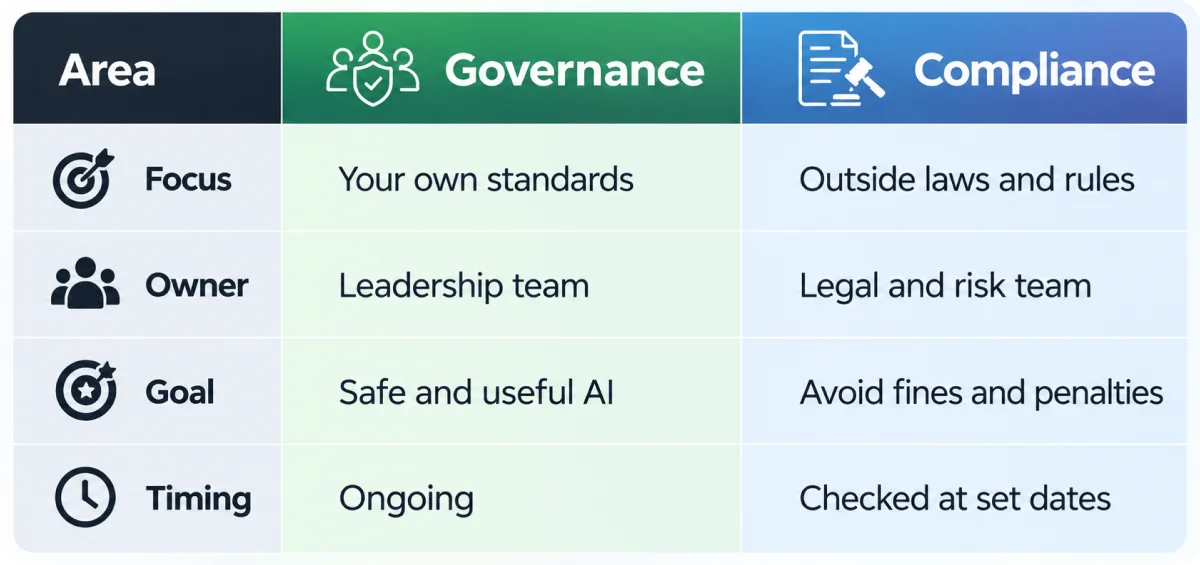
People often mix up these two ideas. Compliance means you follow outside rules. Governance means you also set rules of your own. Auditors check the first one. Your customers feel the second one.
A company can pass an audit and still run risky AI projects. That’s why you need both. Your AI compliance strategy sits inside the bigger governance plan.
Here is a quick comparison.
Risks You Face Without It
-
Data Leaks
Your staff shares data with AI tools every day. Most do it to save time. One paste can expose customer records or trade secrets. Some tools even keep what you send them.
Good AI risk management starts with a few easy questions. Which tools do people use? What data goes in? Where does it go next? Once you have the answers, block the risky paths. Then approve the safe ones.
-
Biased Results
AI learns from past data. That data often carries old bias. For example, a resume screening tool may favor people who look like past hires. Nobody plans it that way. It just happens. The tool can look accurate on paper, so teams may miss the problem for months.
Your artificial intelligence strategy should include bias checks. Test the results across different groups of people. Ask who might get treated unfairly. Fix any problems before launch. A quick test now can save you a public apology later. Share the results with your leaders too.
-
Legal Trouble
Laws on AI keep growing. The EU AI Act is one well-known example. Other regions are writing their own rules. A company that sells in many places has to track all of them. That task grows harder every year. A missed rule can delay a product launch for months.
Smart AI strategy services help you keep up. They map the rules that apply to you. They also flag gaps early. You then fix them on your schedule, and no regulator sets it for you.
Core Parts of a Governance Program
Clear Roles
Every program needs owners. Pick one senior leader to run it. Add a small group from legal, security, IT, and the business side. Meet once a month.
This group approves new tools. It also reviews new use cases. It keeps a short list of approved tools. Strong AI governance needs people who show up and decide. A thick policy binder can’t do that. Choose members who know the daily work. They spot problems that executives miss.
Simple Policies
Policies work best when people read them. Keep each one to a page. Use plain words. Long policies get ignored. Nobody reads forty pages before trying a new tool. Cover the basics first.
- Which AI tools staff may use
- What data staff must never share
- When a human must review AI output
- Who to ask when unsure
Share the policy at onboarding. Repeat it at team meetings. Update it when tools change. A responsible AI strategy keeps its policies short and current. That beats a long, stale document every time.
Model Reviews
Every AI project does not need the same level of review. A tool that drafts internal emails carries low risk. A tool that approves loans carries high risk. Match the review to the risk. Reviewers then spend time where it counts. Teams with safe ideas get a quick yes.
Use this table as a starting point.
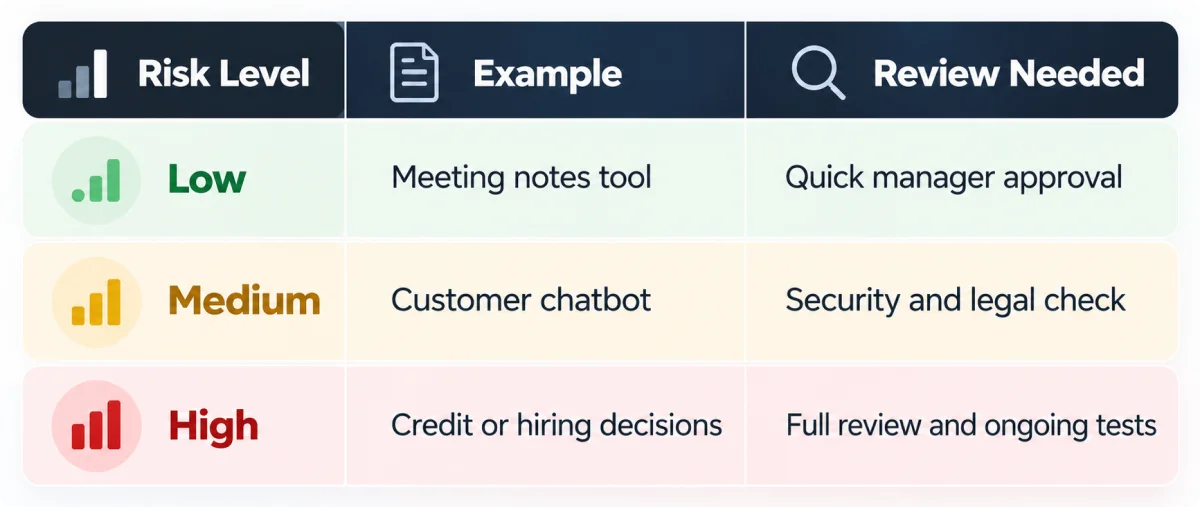
Solid AI risk management saves time here. Tools with low risk move fast. Tools carrying high risk get the attention they deserve. Your reviewers also stop wasting hours on harmless projects. They can spend that time on the cases that matter. Leaders also see a clear record of every decision.
How to Start
-
Take Inventory
You cannot govern what you cannot see. Start by listing every AI tool in use. Ask each department. Check software bills. Look at browser extensions too.
Expect surprises. Many leaders find far more tools than they expected. A marketing team may run three, and finance may run two more. Nobody planned it that way. Experienced AI strategy consulting partners run this discovery in a few weeks. They interview teams and review contracts. You end up with one clear map. That map becomes the base for every later decision.
-
Rank Risks by Level
Next, sort each tool or project by risk. Keep the method simple. Anyone on your team should be able to repeat it. Ask three quick questions.
- Does it use private data?
- Does it affect people’s lives or jobs?
- Does it talk to customers?
Each yes raises the risk level. Your AI compliance strategy then links every level to a review step. High-risk items go to legal. Low-risk items get a quick check. Everyone knows what to expect.
Teams also plan better when they see the steps early. Surprises drop, and projects stay on schedule. Leaders can compare projects side by side too.
-
Train Your People
Rules only work when people know them. Hold a short session for every team. Use real examples from your own work. Show what safe use looks like. Show what unsafe use looks like.
Strong enterprise AI governance treats training as a habit. Repeat it every few months. New tools appear fast. New hires need a quick start. Add the rules to your welcome pack. Give each person a contact for questions. How will your newest employee learn the rules on day one?
How Mobisoft Infotech Helps
Discover
Mobisoft Infotech begins with discovery. This is the first of three phases, followed by strategy and execution. The team sits down with your people and learns how AI is used today.
- Which AI tools and pilots already run
- Who owns each one
- What data each tool can reach
- Where the biggest gaps sit
Your team gets a short summary at the end. It points out risks that need fast action. It also lists easy fixes you can make this month.
AI business consulting at this stage saves you from guessing. You know where to focus before any budget is spent.
Strategize
The team builds your governance plan with you. You join the working sessions. Nothing arrives as a surprise. The plan includes these parts.
- Roles and a review group
- Short policies for staff
- A risk ranking for each use case
- A roadmap with owners and dates
Certified AI specialists check each part. Strong AI strategy services here connect governance to your business goals. Your rules support growth. They do not slow it. You also get a plan that your leaders can read in one sitting. Each owner knows the next step. Each deadline has a name beside it.
Execute
Then the team helps you put the plan to work. This is where policy turns into daily habits.
- Set up access controls and data protection
- Build monitoring for models in use
- Train staff on the new rules
- Provide support around the clock
AI strategy consulting continues after launch. Flexible engagement models let you start with one team and expand. Data security stays a priority at every step. Your team keeps one point of contact, so questions get answers fast. You do not chase several vendors. One team knows your setup from day one.
Final Thoughts
Good governance doesn’t hold AI back. It creates an enabling environment for your teams to operate in. With policies, regulations, and regular audits, random trials will be converted into an AI project that you can proudly present. Customers will be impressed. Auditors, too.
A sound AI strategy begins with baby steps. Choose an owner for the same. Take down a list of all AI technology used by your teams. Identify the level of risks involved. Develop a one-page policy for the same. In one month’s time, you can achieve all this. Finally, check with your team on what they still find unclear.
Each step of the way will help build trust with those you serve. Each step will also ensure that you reduce the chances of having a shock in store for you. The success of your first strategy project will make future budget meetings easy.
Professional AI strategy services will help you fast-track the process. Having an experienced partner on board ensures that you do not make errors.

Comments are closed.