

Your Car Is Scoring Your Driving: What Texas Drivers Should Know About Connected-Car Data and Insurance

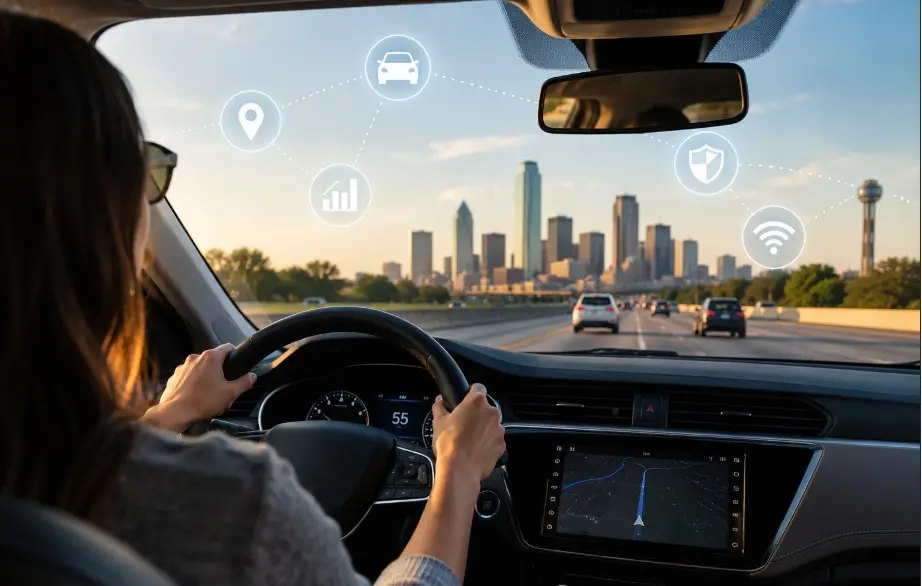
Most people assume their car insurance premium comes down to age, zip code, and claims history. Those still matter. But if your car was built in the last decade, it probably has a cellular modem that logs your speed, braking, and location, and in some cases that data has ended up with the same companies insurers use to price policies.
Texas has become the main battleground over this. The state has sued an automaker and an insurer over driving data, and the outcome affects how anyone with a connected car or a smartphone gets rated here.
How Texas Ended Up at the Center of This
In August 2024, the Texas Attorney General sued General Motors, alleging the company collected driving data from more than 1.5 million Texans through its connected-car services and sold it to third parties, including companies that supply insurers. According to the complaint, that data fed a “driving score” built from things like late-night trips, hard braking, sharp turns, rapid acceleration, and speeds over 80 mph.
A few months later, in January 2025, the state went after Allstate and its data subsidiary Arity. That suit alleges Arity gathered location and movement data from more than 45 million Americans through tracking code embedded in ordinary phone apps, and the AG’s office described it as the first action a state attorney general had brought under a state data privacy law.
Federal regulators followed. In January 2026, the FTC finalized an order that requires GM to get clear consent before collecting or sharing connected-vehicle data and bars it for five years from passing geolocation or driving behavior data to consumer reporting agencies. Many drivers affected by these practices say they had no idea it was happening until a renewal notice came in higher than expected.
Two Ways Your Driving Data Reaches an Insurer
It helps to separate the data you knowingly hand over from the data that travels in the background.
Opt-in telematics. Most large insurers run usage-based programs. You install an app or a plug-in device, it watches how you drive for a set period, and your premium adjusts. You agreed to it, you can see your score, and you can usually quit.
Background collection. This is what the Texas lawsuits target. Automaker connected services (the ones that power remote start, crash notifications, and navigation) can log trip data continuously. Phone apps with a tracking SDK buried inside can do something similar through your phone’s GPS and motion sensors. If that data gets sold to a data broker, it can show up in a risk report an insurer buys when you apply or renew, even if you never signed up for anything labeled “insurance.”
The first path is a trade you choose. The second is the one worth auditing.
What the Scores Actually Measure
The behaviors named in the GM complaint line up closely with what telematics programs track generally:
- Hard braking and rapid acceleration
- Sharp or fast cornering
- Sustained high speed
- Time of day, with late-night driving weighted as riskier
- Phone handling while the car is moving
Some of these don’t map neatly onto Texas roads. Parts of I-10 and I-20 in West Texas are posted at 80 mph, and a stretch of SH 130 near Austin allows 85. A driver doing the legal limit out there can rack up “high speed” flags that a model built on national averages treats as reckless. Rush hour on I-35 through Austin or US-59 in Houston is its own problem, because stop-and-go traffic produces hard-braking events even for careful drivers. And anyone working a night shift at a refinery, hospital, or distribution center gets dinged for time of day through no fault of their driving.
Highway Habits Are Where Scores Get Won or Lost
Because so much Texas driving happens on high-speed corridors, highway behavior tends to dominate any score. Smooth merging, leaving enough following distance that you rarely need to stomp the brake, and settling in the right lanes rather than weaving all register well with the algorithms, and they also happen to be what keeps you out of a crash.
That makes new drivers the most exposed. A teenager or someone who just moved from a smaller state and is learning the Dallas High Five interchange will brake hard more often simply because the traffic patterns are unfamiliar. If that’s someone in your household, going over some basic tips for driving on a highway before they put real miles on the car is worth doing before you enroll them in any monitored program. A rough first month can set the baseline the discount is calculated from.
Is the Telematics Discount Worth It?
For some drivers, yes. If you drive mostly during the day, cover modest mileage, and don’t commute through heavy traffic, an opt-in program can knock a real amount off your premium.
For others, the math is less friendly. Before enrolling, ask the insurer two direct questions. First, can the program raise your rate, or can it only lower it? Policies differ, and some carriers that once promised “discount only” have changed terms. Second, how long is the data kept, and is it shared with anyone outside the company? You want those answers in writing, not from a sales script.
Night-shift workers, rideshare drivers, and people with long highway commutes should be especially careful. The scoring models weren’t built around their schedules.
How to Check What’s Already Been Shared
You don’t have to guess. A few practical steps:
- Open your car’s companion app or connected-services account. Look for anything labeled driving insights, smart driver, driver feedback, or data sharing, and turn off what you don’t use. Some manufacturers bury these settings two or three menus deep.
- Request your consumer disclosure report from LexisNexis Risk Solutions. Under federal credit reporting law you’re entitled to see what a consumer reporting agency holds on you. If driving data you never agreed to share shows up, you can dispute it.
- Use your rights under the Texas Data Privacy and Security Act. Since July 2024, Texans have had the right to ask covered businesses what personal data they hold and to request deletion.
- Audit location permissions on your phone. Apps that have no reason to know where you’re driving (games, coupon apps, some weather apps) shouldn’t have “always” location access.
None of this takes more than an afternoon, and it tells you whether your premium is being shaped by data you didn’t knowingly provide.
Shopping for Coverage With Data in Mind
Most comparison pages for car insurance Texas drivers pull up focus on the monthly number, not on how each carrier rates you. So you’ll have to ask. When you request quotes, find out whether the insurer buys third-party driving scores, whether its telematics program is optional, and what happens to your data if you cancel.
Keep the coverage levels identical across quotes so you’re comparing like for like. Texas requires at least 30/60/25 in liability coverage, but that floor is thin against today’s truck prices and medical bills, so most drivers are better off quoting higher limits and matching uninsured motorist coverage to them.
It also helps to get quotes from different kinds of companies. National carriers tend to lean hardest on telematics. Regional insurers sometimes price local risk differently; GoAuto Insurance, for instance, is a regional company offering cheap car insurance in Texas, and putting a quote like that beside two national ones shows you quickly whether a monitoring discount beats a lower base rate.
The Short Version
Your car and your phone may already be producing a driving profile, and Texas law and recent enforcement give you more ways than ever to see it and limit it. Check your connected-car settings, pull your disclosure report, and ask every insurer how it uses driving data before you renew. A telematics discount can be a good deal, but only if you know what you’re trading for it.

Comments are closed.